
Only COD || Advance में ₹1 भी नहीं देना है
Nvidia CEO Jensen Huang 2026

Nvidia CEO Jensen Huang 2026: AI Jobs, India Impact and New Chip Updates Explained

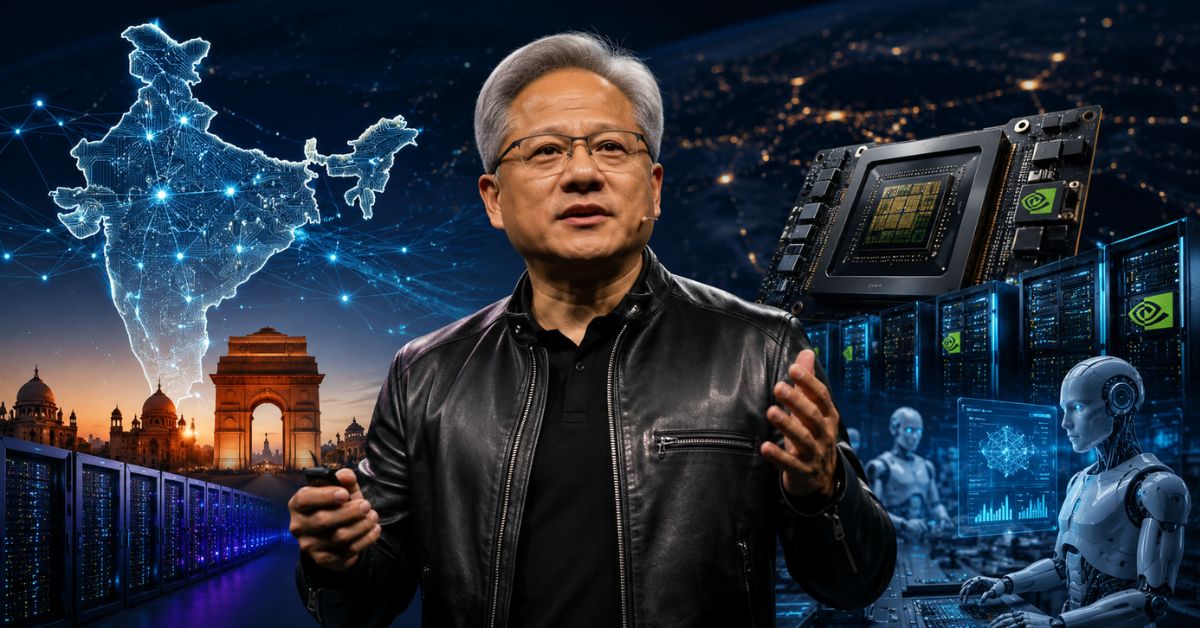
Nvidia CEO Jensen Huang is again in the news in 2026 because of three big developments: Nvidia’s new AI chip roadmap, his comments on AI and jobs, and the growing tension around advanced chip exports to China. For India, this matters because AI computing power, data centres, semiconductor policy and AI jobs are now directly linked to the country’s digital growth.
What Happened?

In 2026, Jensen Huang has been at the centre of several major AI discussions. Nvidia announced new AI infrastructure plans at CES and GTC 2026, including the Vera Rubin platform for large-scale AI factories. Nvidia said the Vera Rubin platform includes seven new chips in full production and is designed for advanced AI work such as pretraining, post-training and agentic inference.

At the same time, Huang’s public comments on AI jobs and the US-China chip race have attracted attention in India. He has argued that AI can create jobs, not only remove them. Nvidia’s own post quoted him as saying that AI has created more than half a million jobs and that companies using AI can grow faster and hire more people.

Who Is Jensen Huang?

Jensen Huang is the founder and CEO of Nvidia. According to Nvidia’s official profile, he founded the company in 1993 and has served as its president, CEO and board member since the beginning. Nvidia says its invention of the GPU in 1999 helped grow the PC gaming market and later became important for modern AI.

Today, Huang is seen as one of the most important voices in the AI industry because Nvidia’s GPUs are used to train and run many advanced AI systems. This is why his comments are closely watched by investors, governments, startups and technology companies.

Key Details From Nvidia’s 2026 AI Push

Nvidia used CES 2026 and GTC 2026 to show how it sees the next phase of AI. At CES 2026, Huang said AI was moving into every domain and every device, according to Nvidia’s official blog.

At GTC 2026, Nvidia highlighted AI factories, accelerated computing, open models, agentic systems and physical AI. Nvidia also said Huang announced the Vera Rubin DSX AI Factory reference design and Omniverse DSX Blueprint, which are meant to help companies plan and simulate AI factories before building them.

For readers in India, the simple meaning is this: AI is no longer only about chatbots. The next phase is about large data centres, power supply, networking, advanced chips, cloud platforms, robotics and industry use cases.

India AI Impact Summit 2026: Jensen Huang’s Absence Also Made News

Jensen Huang was expected to attend the India AI Impact Summit 2026, but Reuters reported on February 14, 2026, that he would not travel to India due to “unforeseen circumstances.” The report said he was expected to be one of the major attractions at the summit and was also due to address the media in New Delhi.

The summit itself was important for India. A PIB release said India was preparing to host the first global AI summit in the Global South from February 16 to 20, 2026, at Bharat Mandapam in New Delhi. The government said the summit focused on safe, trusted and inclusive AI.

The official India AI Impact Summit website described the event as a move from discussion to real-world impact, with focus on people, planet and progress. It also said the India AI Impact Expo 2026 would bring together more than 300 exhibitors from India and over 30 countries.

Why Jensen Huang’s AI Jobs Comment Matters in India

AI job loss is a major concern in India, especially for IT workers, engineering graduates, BPO employees and young professionals entering the workforce. Huang’s view is more positive than many AI warnings. He says AI can create new work because companies that use AI can become more productive and expand faster.

TechCrunch also reported that Huang said AI is creating jobs and described AI infrastructure as a new kind of industrial buildout. He also warned that fear-based stories about AI could stop people from learning and using the technology.

For India, this is important because the country has a large tech services workforce. AI may change many roles, but it can also create demand for AI engineers, data centre workers, chip design talent, cloud specialists, AI safety experts, prompt engineers and domain experts who can apply AI in sectors like healthcare, education, agriculture, finance and manufacturing.

US-China Chip Tension: Why India Should Watch Closely

Another major reason Jensen Huang is trending in 2026 is his comment on Nvidia’s China business. Reports said Huang claimed Nvidia’s AI accelerator market share in China had fallen to zero after US export controls. The Times of India reported that Huang also said the US should keep the best AI technology first, especially advanced chips such as Blackwell and Rubin.

Tom’s Hardware reported similar comments from Huang at the Milken Institute Global Conference, saying he supported the US having “the first, the most, and the best” in AI hardware, while also arguing that US companies should not fully abandon global markets.

For India, this chip tension matters because it can affect global AI hardware supply, data centre costs and the speed at which companies can access powerful computing. It also opens a strategic opportunity for India to build stronger AI infrastructure, semiconductor partnerships and domestic chip design capabilities.

Impact in India

India is trying to become a major AI hub. The country has a strong software talent base, a growing startup ecosystem and rising demand for AI in public services and private industry. But AI growth also needs high-performance computing, reliable power, data centres, skilled workers and access to advanced chips.

Nvidia’s 2026 roadmap matters because Indian startups and enterprises depend heavily on GPU infrastructure to build AI tools. If global chip supply becomes tighter or more expensive due to export controls and geopolitical competition, Indian companies may face higher costs.

At the same time, India can benefit if global companies look for trusted partners outside China. India’s focus on AI missions, digital public infrastructure and semiconductor manufacturing could attract more investment if policy execution remains strong.

Background: Why Nvidia Is So Important to AI

Nvidia started as a graphics chip company, but its GPUs became useful for AI because they can process many tasks at the same time. This made them important for training large AI models and running AI applications at scale.

That is why Nvidia’s product announcements are now followed like major economic news. When Nvidia talks about AI factories, it is talking about a future where computing infrastructure becomes as important as roads, power plants and telecom networks.

What Happens Next?

The next thing to watch is how quickly Nvidia’s Vera Rubin platform moves from production announcements to wider customer use. Indian companies will also watch GPU pricing, cloud availability and whether local data centre operators can get enough advanced AI hardware.

India’s AI policy direction after the India AI Impact Summit will also matter. If the government supports compute access, startup funding, AI safety standards and skill development, India can gain from the AI wave instead of only consuming foreign technology.

Read More : Apple iPhone 16 256GB Black A18 Chip 5G

Another key area is jobs. Huang’s message is that AI can create work, but India will need rapid reskilling. Workers who learn AI tools, data skills, automation workflows and domain-specific AI use cases may be better placed than those who ignore the change.

Official Updates and What Is Still Unclear

The confirmed updates are clear: Nvidia officially announced major AI infrastructure developments at GTC 2026, India officially hosted the India AI Impact Summit in February 2026, and Reuters reported that Huang did not attend the summit due to unforeseen circumstances.

What is still unclear is how much direct Nvidia investment or deeper Nvidia-India partnership activity will happen in 2026. It is also unclear how global chip export rules will affect India’s access to the newest AI hardware over the long term.

WhatsApp Channel
Compare (0)