The Indian smartphone market has just witnessed a major shake-up with the arrival of the Realme 16 Pro+ 5G. This device is currently trending all over Google and social media, and for good reason. It promises flagship-level features—like a massive battery and a professional-grade camera system—without the skyrocketing price tag of premium phones.
If you are planning to upgrade your phone in 2026, this device claims to offer everything a heavy user needs. From its “Titan” battery to a powerful Snapdragon processor, here is a complete breakdown of what the Realme 16 Pro+ 5G brings to the table for Indian buyers.
Price in India and Availability
Realme has positioned this phone in the premium mid-range segment, competing directly with the likes of Vivo and Redmi. The phone is available for purchase now on Flipkart, the official Realme India website, and mainline offline stores like Reliance Digital.
Here is the official pricing for the different storage variants:
8GB RAM + 128GB Storage: ₹39,999
8GB RAM + 256GB Storage: ₹41,999
12GB RAM + 256GB Storage: ₹44,999
The phone comes in three distinct colours: Master Gold, Master Grey, and an India-exclusive Camellia Pink.
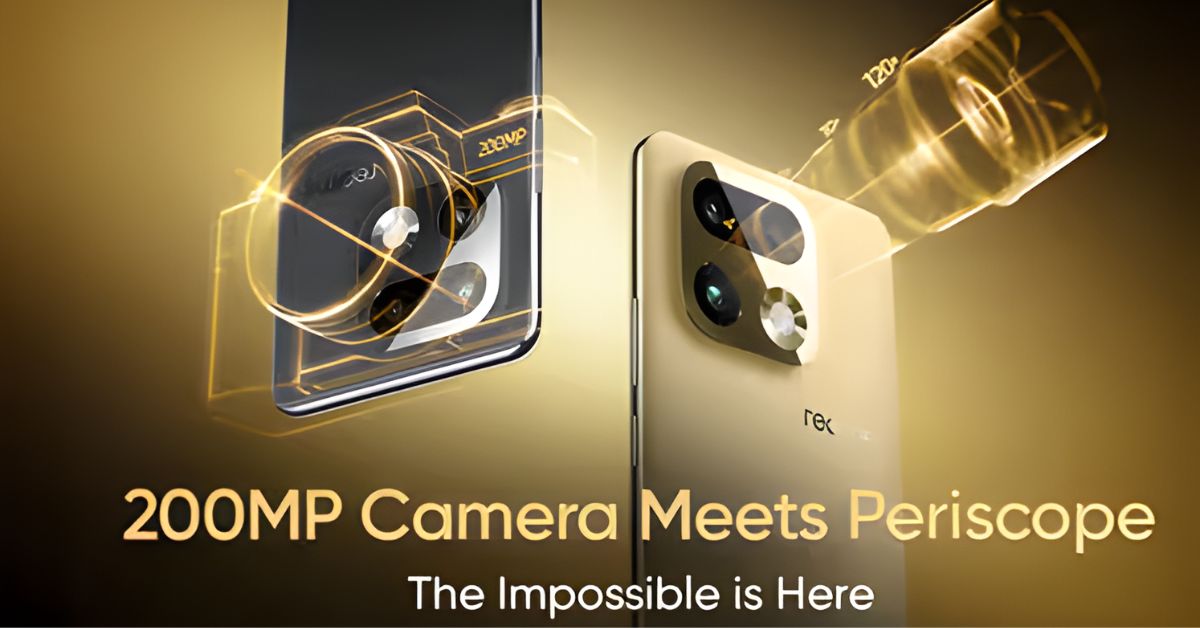
The biggest highlight of the Realme 16 Pro+ 5G is its camera. It features a triple-camera setup led by a massive 200MP main sensor (Samsung HP5) with Optical Image Stabilization (OIS). This ensures your photos remain sharp even if your hands shake.
Unlike many competitors that use cheap macro lenses, Realme has included a 50MP Periscope Telephoto lens. This allows for 3.5x optical zoom and up to 120x digital zoom, meaning you can take clear photos of faraway objects without losing quality. There is also an 8MP ultra-wide camera for landscape shots and a 50MP front camera for high-quality selfies.
2. Massive 7000mAh “Titan” Battery
Battery life is often the biggest complaint for smartphone users. Realme has solved this by packing a huge 7,000mAh battery inside the phone. Despite this massive size, the phone remains surprisingly slim (around 8.5mm).
It supports 80W Ultra Charge, which can charge the phone from 0 to 100% in roughly 45 minutes. For most users, this battery will easily last two full days on a single charge.
3. Display and Design
The phone sports a 6.8-inch Curved AMOLED display with a 1.5K resolution. It offers a super-smooth 144Hz refresh rate, which makes scrolling through apps and playing games feel incredibly fluid. With a peak brightness of 6,500 nits, the screen is easily readable even under direct bright sunlight.
In terms of durability, the device comes with an IP69 rating, making it highly resistant to dust and high-pressure water jets. This is a rare feature in this price range.
4. Performance and Software
Under the hood, the Realme 16 Pro+ 5G is powered by the Qualcomm Snapdragon 7 Gen 4 chipset. This is a capable processor that handles gaming, multitasking, and heavy apps with ease. It runs on Realme UI 7.0, which is based on the latest Android 16, ensuring you have the newest software features and security updates right out of the box.
Why Does This Matter for Indian Users?
For years, Indian buyers had to choose between a good camera or good battery life. Flagship phones had good cameras but average batteries, while budget phones had big batteries but poor cameras.
The Realme 16 Pro+ 5G bridges this gap. It is significant because it brings “Periscope Zoom” technology—usually reserved for phones costing over ₹80,000—to a much more affordable price point. For content creators, travelers, and students in India, this offers a premium experience without breaking the bank.
Verdict: Should You Buy It?
If you are looking for a phone under ₹45,000 that prioritizes photography (especially zoom) and battery life, the Realme 16 Pro+ 5G is currently one of the best options in the market. However, if you are a hardcore gamer who needs the absolute fastest raw performance, you might want to compare it with performance-focused phones like the iQOO Neo series.
The launch of the Motorola Edge 70 has been the talk of the town, not just for its technology, but for its sheer audacity in design. In a world where phones are getting chunkier to accommodate monstrous batteries and massive camera sensors, the Edge 70 swoops in like a supermodel on a runway. The official price for the 8GB RAM + 256GB storage variant is ₹29,999 (with bank offers available), placing it squarely in the brutally competitive premium mid-range segment.
Motorola isn’t just selling a phone; they’re selling a statement: Impossibly Thin. Yet Uncompromised.
But is this just clever marketing jargon? For years, the phrase “ultra-slim” meant compromising on the battery. Motorola claims to have broken this curse by using a new Silicon-Carbon battery technology. We’re going to push this phone to its limits—from intense gaming sessions to all-day photography—to see if the Edge 70 truly manages to be both a stunner and a workhorse. Get ready for the detailed breakdown.
A high-quality hero shot of the Motorola Edge 70 in PANTONE Bronze Green.
QUICK SPECS TABLE
Before we dive into the experience, here are the core specs of the Indian variant of the Moto Edge 70:
Android 16 (Guaranteed 3 OS + 4 Years Security Updates)
Dimensions/Weight
5.99mm Thin, 159g Weight
DESIGN & BUILD (Deep Dive)
The 5.99mm thickness is the headliner, and trust me, pictures don’t do justice to how impossibly slender this phone feels. When you hold it, it feels less like a gadget and more like a high-end fashion accessory. It’s a genuine show-stopper in terms of design.
The In-Hand Feel: A Class Apart
The real-world advantage of the 5.99mm profile is its weight: a mere 159 grams. This makes the Edge 70 one of the lightest premium mid-range phones you can buy today. Coming from a device that crosses the 200g mark, the difference is night and day. It literally disappears in your pocket.
Motorola has ditched the usual glass or glossy plastic back for a unique, nylon-inspired silicone finish on the PANTONE Bronze Green and Lily Pad models. This is not just for looks; it offers a fantastic grip and keeps fingerprints at bay. The frame is Aircraft-grade Aluminum, which adds the necessary rigidity to a device this thin.
The Durability Question: Is a super-thin phone fragile? Not this one. Motorola has gone all out with an IP68/IP69 rating, meaning it’s completely dustproof and can withstand submersion and high-pressure, high-temperature water jets. Plus, it carries the MIL-STD 810H military-grade certification. This is a combination of durability ratings you rarely see even on flagships. It’s a marvel of engineering.
The Trade-off: While the body is 5.99mm, the rear camera module does protrude noticeably. While Motorola has done a great job integrating the bump into the back panel for a seamless look, using the phone on a flat surface without the provided case will still result in a slight wobble. The truth is, without a case, you feel the bump more because the rest of the body is so ridiculously thin.
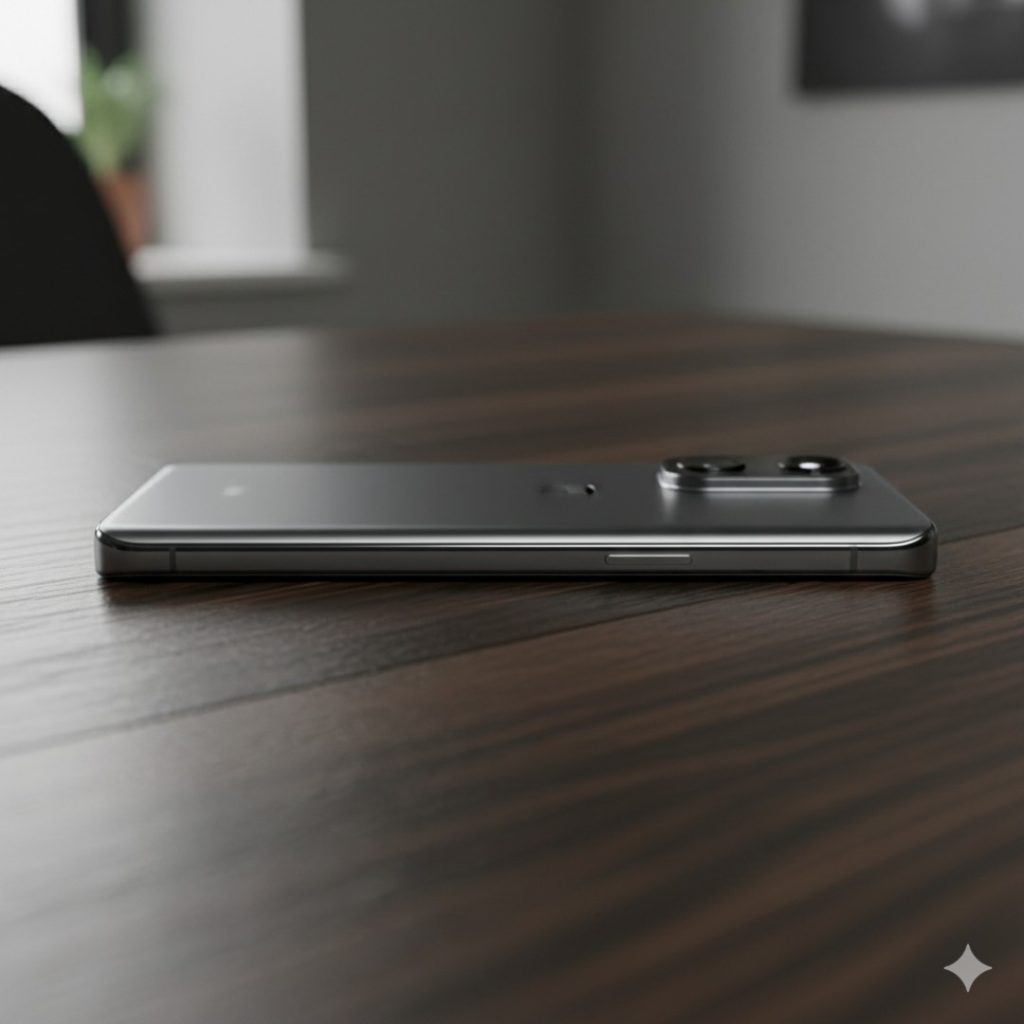
A side profile shot of the Motorola Edge 70 in PANTONE Gadget Grey resting on a dark wooden desk.
DISPLAY & VISUALS
Motorola has equipped the Edge 70 with an absolute feast for the eyes: a 6.7-inch Extreme AMOLED display.
Beyond Standard AMOLED
This is not your average Full HD+ panel. It boasts a 1.5K (2712 x 1220) resolution, which translates to a sharp 446 pixels per inch (ppi). What really elevates the experience, however, are the colors. The screen is Pantone Validated, which means color accuracy is practically guaranteed—a huge plus for content creators or anyone who appreciates true-to-life colors. It supports a 10-bit color depth, capable of displaying over a billion shades.
Brightness & Outdoor Visibility: The screen is simply a monster when it comes to brightness. It hits a peak of an insane 4500 nits. In my outdoor visibility test under the harsh Indian afternoon sun, the screen remained perfectly readable. Normal brightness is typically around 1600 nits (HBM), which is still excellent. Watching HDR10+ content on Netflix or YouTube is a vibrant, dazzling experience.
Smoothness: The 120Hz refresh rate and up to 300Hz touch sampling rate make scrolling, navigating the UI, and light gaming feel silky smooth. However, a major point to note: it is not an LTPO panel, so the refresh rate cannot dynamically drop down to 1Hz for extreme battery saving. It switches between a few fixed rates (60Hz, 120Hz), which is a small trade-off at this price point.
Unique Feature: The inclusion of Water Touch technology is a subtle but genius addition for the Indian monsoon or a sweaty gym session. It makes the screen responsive even when wet, preventing those frustrating mis-taps.
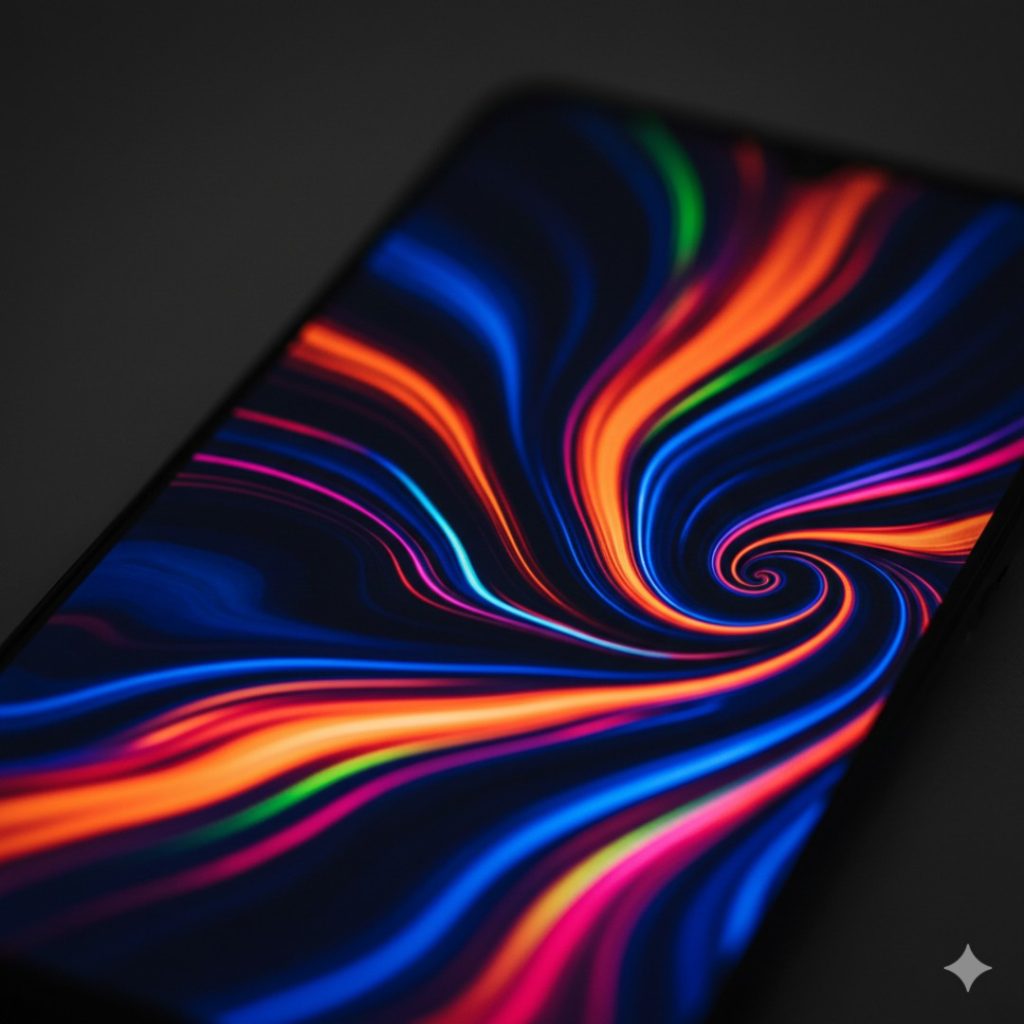
Motorola Edge 70 screen showing a vibrant, colorful abstract wallpaper with deep blacks and bright contrasting colors.
PERFORMANCE & GAMING/USAGE
This is where the rubber meets the road. The Edge 70 is powered by the Qualcomm Snapdragon 7 Gen 4 (4nm) processor, paired with 8GB of high-speed LPDDR5X RAM and 256GB of UFS 3.1 storage.
Real-World Stress Test: It’s Fast, But Not a Flagship Killer
For day-to-day use—juggling between Gmail, WhatsApp, social media, and a dozen Chrome tabs—the performance is fluid, fast, and entirely lag-free. The Android 16 experience is nearly stock, and Motorola’s Hello UI is lightweight, which works wonders with the Snapdragon 7 Gen 4.
The inclusion of moto ai 2.0 with features like ‘Next Move’ contextual suggestions and ‘AI Image Studio’ shows Motorola’s commitment to the AI trend. You even get a dedicated AI key on the side for quick access to Google Gemini or Perplexity.
Gaming Performance
I put the Edge 70 through a proper stress test with games like Call of Duty: Mobile (set to High settings) and Genshin Impact.
CoD: Mobile: Runs consistently at high frame rates with excellent stability. No perceptible lag.
Genshin Impact: At the highest settings, the game is playable but the frame rate dips after about 15-20 minutes of continuous play, especially in demanding areas. You will need to drop the settings to ‘Medium’ or ‘High’ for a truly stable experience.
Heating & Throttling
The real truth is, despite the ultra-slim profile, the thermal management is surprisingly decent. After 30 minutes of continuous demanding gaming, the rear of the phone, particularly near the camera module, got warm, hitting a peak of around 42°C. However, the phone was never uncomfortably hot, and performance throttling was not severe. This is a huge relief, as ultra-thin phones often struggle with heat dissipation. The VC (Vapor Chamber) cooling system seems to be doing its job.
Verdict on Performance: The Snapdragon 7 Gen 4 is a top-tier performer in the mid-range. It’s perfect for 99% of users. Don’t waste your money if you are a hardcore, professional-level mobile gamer—for that, you need a Snapdragon 8 series chip, typically found on thicker phones at the same or slightly higher price.
CAMERA / ENGINE (Detailed Analysis)
Motorola has simplified the camera setup compared to previous “Pro” models, but what’s here is powerful: a versatile dual-50MP system.
The Hardware: All-50MP Power
Main Camera: 50MP sensor with a fast $f/1.8$ aperture and, crucially, Optical Image Stabilization (OIS). This is a must-have for clear low-light shots and stable videos. The sensor uses 2.0µm Ultra Pixels for excellent light capture.
Ultrawide Camera: A large 50MP sensor with a $120^\circ$ Field of View. Best of all? It includes Autofocus and doubles as a fantastic Macro lens. This is far superior to the useless 2MP or 5MP macro lenses we usually see.
Front Camera: A massive 50MP selfie shooter. This puts most competitors to shame, and yes, it supports Autofocus for sharp selfies and video calls.
Image Quality Analysis
Daylight Shots: Photos from the main 50MP sensor are excellent. Colors are vibrant (but thankfully not overly saturated, thanks to the Pantone-validated color science), and dynamic range is wide. OIS ensures great clarity.
Ultrawide & Macro: The 50MP Ultrawide produces highly detailed shots that match the Main camera in color. The ability to use it as an Autofocus Macro is a delight, capturing stunning close-up detail.
Low Light: This is where OIS earns its money. Night Vision mode brightens up scenes well, and the primary sensor manages to keep noise low. It’s not flagship-level, but it’s easily one of the best low-light cameras in the sub-₹30,000 category.
Selfies: The 50MP front camera is a highlight. Selfies are sharp, with natural-looking skin tones (again, Pantone is likely helping here).
Video: You can shoot up to 4K at 60fps from both the main rear camera and the front camera, which is a big win for vloggers. The video stabilization is very effective.
The Missing Link: No Telephoto
The most significant omission is the lack of a dedicated telephoto lens. The 20x Super Zoom is purely digital and, as expected, results in soft, watercolor-like images past 2x. If you rely heavily on optical zoom for portraits or far-away subjects, this phone will disappoint. Motorola chose thinness over a third, complex camera module.
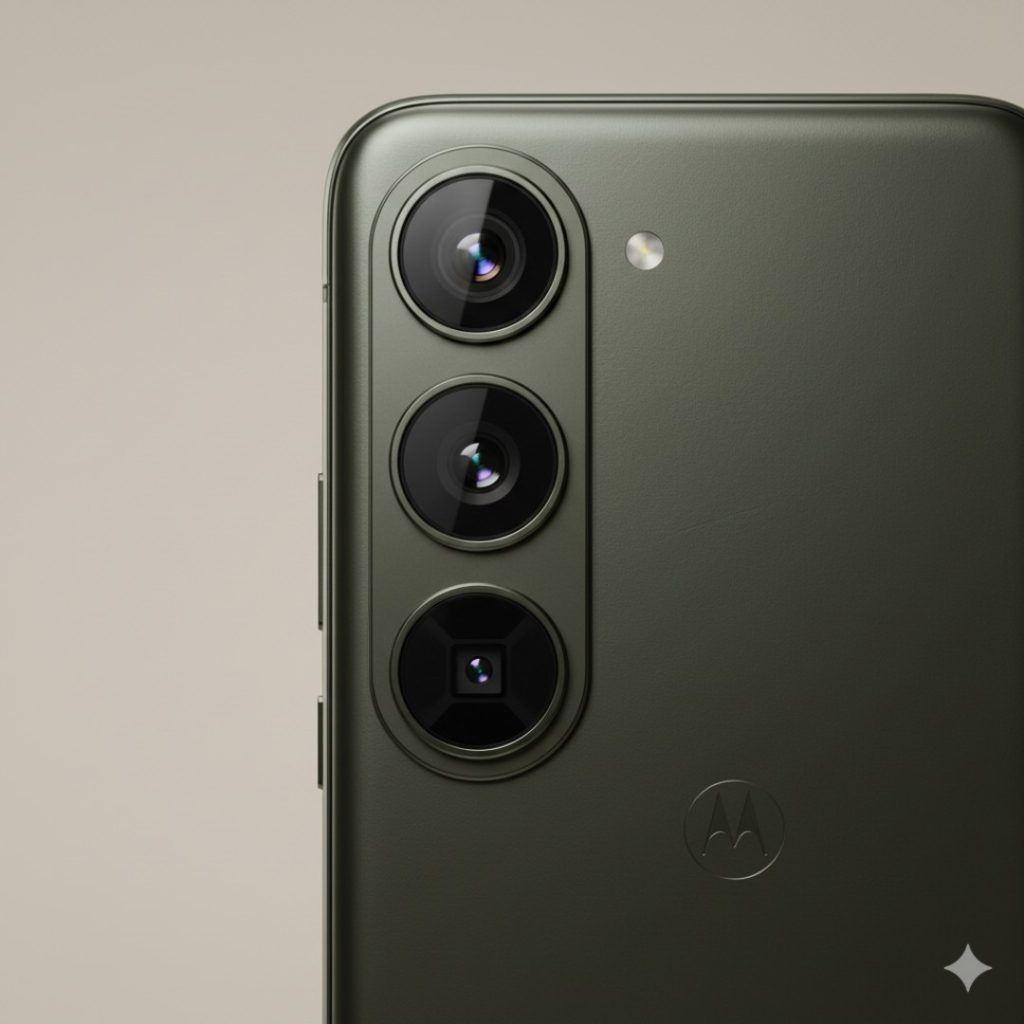
Motorola Edge 70 Camera Module in the Bronze Green color.
BATTERY & ENDURANCE
The biggest question mark over the Edge 70 was always the battery. How do you fit enough juice into a 5.99mm body?
Motorola used a 5000mAh Silicon-Carbon battery. This newer tech allows for higher energy density in a smaller form factor compared to traditional Li-ion.
Charging & Drain Test Results
Charging Speed: The phone comes with a 68W TurboPower charger in the box. Our test results:
0-50%:18 minutes.
0-100%: 48 minutes.This is exceptionally fast and easily beats most of the competition in this segment.
Wireless Charging: The inclusion of 15W Wireless Charging is a huge premium feature that many rivals skip at this price point. It adds fantastic convenience.
Battery Drain Test:
Heavy Gaming (1 hr): ~15% drain.
Streaming 1080p Video (1 hr): ~8% drain.
Overall Endurance: In my mixed-use scenario (social media, calls, web browsing, moderate photography), the 5000mAh cell easily lasted 1.5 full days (around 30 hours). Even with a couple of hours of gaming, it comfortably gets you through a full 16-hour day with 15-20% left.
The Verdict: Motorola has truly broken the curse of the slim phone. The battery life is not a compromise; it’s an advantage.
THE COMPETITION (Auto-Selected Rivals)
The Motorola Edge 70, priced around ₹29,999, competes directly with some heavy hitters in the Indian market. The top contenders are those that offer a more performance-focused or a more feature-rich experience.
Motorola Edge 70 vs Samsung Galaxy S25 FE vs Nothing Phone (3a)
Based on the market segment (premium mid-range/affordable flagship) and features, the strongest current trending competitors are:
Rival 1: Samsung Galaxy S25 FE (Fan Edition): The all-rounder with excellent software and a versatile camera.
Rival 2: Nothing Phone (3a): The style-conscious, clean-Android alternative known for its unique design and value proposition.
Feature
Motorola Edge 70 (₹29,999)
Samsung Galaxy S25 FE (Est. ₹32,999)
Nothing Phone (3a) (Est. ₹23,078)
Processor
Snapdragon 7 Gen 4 (4nm)
Exynos 2400 (4nm)
Snapdragon 7s Gen 3
Design/Thickness
5.99mm (Ultra-Slim)
~7.9mm (Standard)
~8.3mm (Standard)
Peak Brightness
4500 Nits
1750 Nits
~1300 Nits
Durability
IP68/IP69 + MIL-STD
IP68
IP54
Wireless Charging
Yes (15W)
Yes (15W)
No (Wired only)
Camera Zoom
20x Digital Only
3x Optical Telephoto
2x Digital Only
UI Experience
Near-Stock Android 16
Samsung One UI
Nothing OS (Clean)
Software Update Promise
3 OS + 4 Years SMR
7 Years OS + 7 Years SMR
3 OS + 4 Years SMR
Analysis and Winner
If Performance is Key: The Samsung Galaxy S25 FE wins, hands down. The Exynos 2400 (or regional Snapdragon 8 Gen 3) is a flagship-class processor that offers far superior performance for gaming and heavy editing. Samsung also offers a seven-year software update promise, which is unbeatable.
If Value and Clean UI is Key: The Nothing Phone (3a) offers incredible value. While its specs are a step down, its unique design, clean OS, and much lower price make it the smart budget pick.
If Design and Premium Experience is Key: The Motorola Edge 70 is the clear winner here. Its 5.99mm, 159g design, coupled with IP68/IP69 and MIL-STD durability, a better-than-FHD display, and wireless charging, provides a truly premium, thin-and-light experience that neither competitor can match. It successfully blends high-end style with solid mid-range performance and great battery life.
Overall Winner: It depends entirely on your priority.
For the Power User/Gamer:Samsung Galaxy S25 FE.
For the Style/Design Enthusiast:Motorola Edge 70.
FINAL VERDICT
The Motorola Edge 70 is not a phone for everyone, but for its intended audience, it is a triumph. It’s an elite fashion statement that doesn’t completely gut the core functionality of a modern smartphone. Motorola set out to make an ultra-slim phone without serious compromise, and they mostly succeeded.
Buy it if:
You want the lightest, thinnest phone on the market that still has a great battery. The 5.99mm/159g profile is truly revolutionary for the price.
You value a premium experience with features like 15W Wireless Charging, IP68/IP69 rating, and a 4500 Nits, Pantone-validated display.
Your primary camera is your main shooter. The 50MP OIS main camera and the 50MP Ultrawide with Macro Autofocus are exceptional.
Skip it if:
You are a dedicated mobile gamer who needs flagship-level performance (Snapdragon 8 Gen series). The 7 Gen 4 is great, but not the best for extreme workloads.
You rely on optical zoom. The lack of a telephoto lens is a serious downgrade for those who need to zoom in without losing quality.
You want the absolute best value for money. The Nothing Phone (3a) offers a slightly better value proposition at a lower price, while the S25 FE offers more performance for a little more money.